Built to hold up.

See ground movement under your infrastructure —
week over week, from space.

GroundPulse turns NASA and ESA satellite data into ground-movement intelligence for the assets you actually own — bridges, pipelines, and roadway corridors today, more modules as the work calls for them.

10 years
Historical displacement archive
<1 mm
Measurement precision
Sentinel-1
OPERA DISP today; NISAR L-band when validated products land
Day one
Full archive on signup

Government & academic users: displacement monitoring for up to 500 bridges or 100 corridor miles.

Get Started
groundpulse.io/app
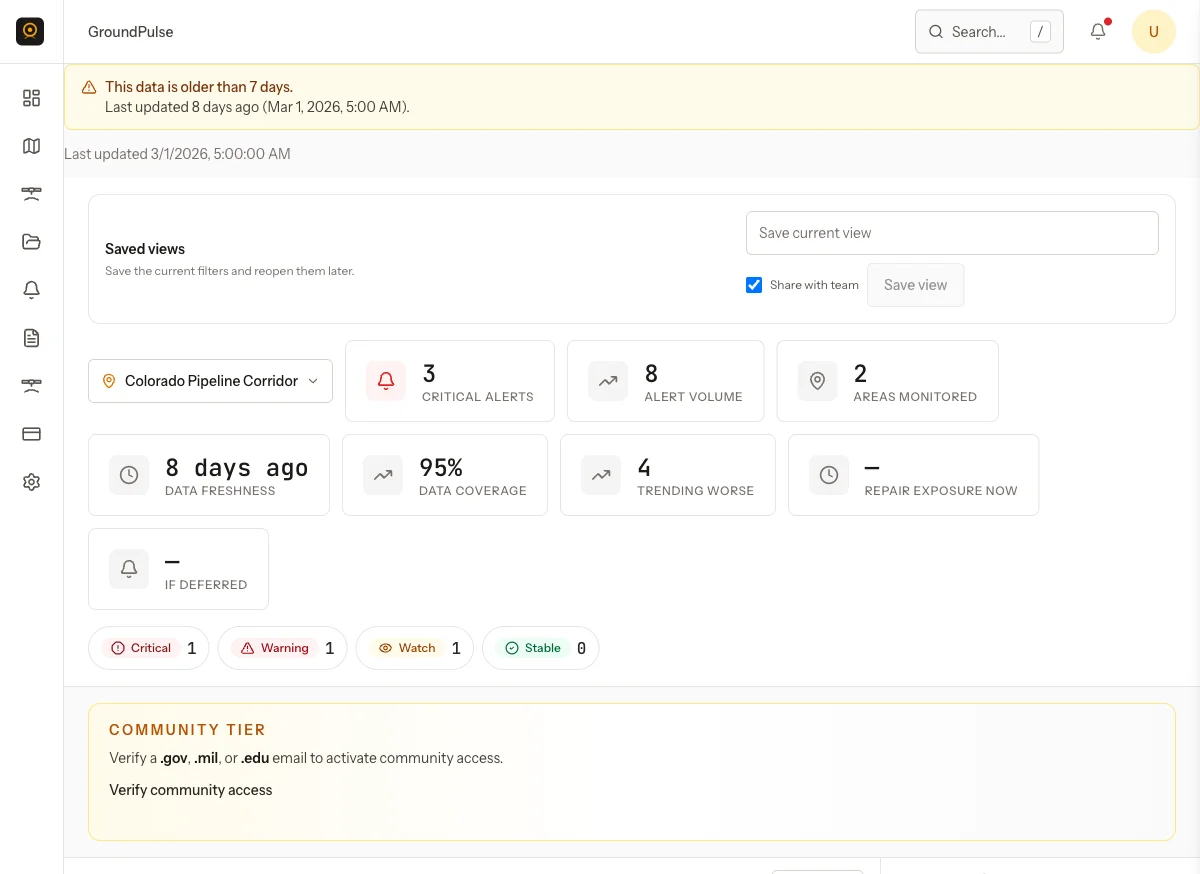
GroundPulse dashboard showing pipeline corridor monitoring with KPI cards, risk tier badges, and displacement alerts and risk scoring

Thousands of miles.
Millions of blind spots.

Ground sensors cost $10K-$100K each and cover single points. Everything between them is invisible. Satellite InSAR changes that.

Ground sensors are sparse and expensive

Inclinometers, tiltmeters, and GPS stations cost $10K-$100K+ per point. You can only instrument known risk locations.

Satellite InSAR covers everything

NASA's OPERA DISP products deliver analysis-ready displacement maps covering your entire asset footprint.

InSAR consultants are slow and costly

Traditional providers charge $100K+ per project, take weeks, and require radar science expertise.

GroundPulse automates the intelligence

We process satellite data, join it to your assets, calculate risk scores, and deliver alerts. No remote sensing expertise needed.

Asset-type modules on a shared monitoring stack.

One platform underneath every module — the same InSAR ingest, ground-motion analytics, scoring, and workspace, wrapped around a different asset schema. New modules ship when the market signal calls for them.

Bridges Controlled demo

Network-wide displacement screening with NBI asset context, screening exports, and IIJA-aligned reporting. Built and exercised against the Montana state inventory.

  • Screen entire bridge networks for active ground movement
  • NBI integration with condition rating overlay
  • Per-structure velocity, confidence, and risk tier
  • IIJA justification reports for funding applications

Pipelines Controlled demo

PHMSA-aligned geohazard screening across right-of-way corridors. Segment-level ranking, displacement history, quality scoring, and pipeline-specific risk rules.

  • Corridor-wide displacement at segment level
  • Supports API RP 1187 Level 1 screening (landslide) and 49 CFR 192.917 / ASME B31.8S (other geohazards)
  • Watch / warning / critical thresholds with alert events
  • GeoJSON / Shapefile / Esri-ready exports

Roadways Controlled demo

Corridor and district-level displacement monitoring for highway and roadway networks. Geohazard classification, cut/fill context, and district dashboards.

  • Network-wide corridor screening with district rollups
  • Geohazard taxonomy: landslide, rockfall, subsidence, embankment settlement
  • Cut / fill / at-grade context per segment
  • Field-validation status tracking

Private dams Scoping

Asset model, ingest, and displacement endpoints in place; productized UX and reference artifact in scoping. Targeted at high-hazard private dams and small hydro under FERC.

  • Asset schema and ingest path operational
  • Displacement endpoint per dam crest
  • FERC-compliance reporting scoped, not yet built

Transmission & distribution, ports, and rail embankments are candidate modules. Sequence is set by buyer signal, not a roadmap.

Built for the people who own the assets.

Pipeline operators

Directors of integrity management at interstate gas, oil, and NGL operators with PHMSA-regulated mileage and right-of-way exposure. The pipeline module is exercised against real corridors today; we're open to controlled-pilot conversations.

Private dam & small-hydro owners

Dam safety officers and FERC-compliance leads at industrial dam owners and independent hydro operators. Module scoping starts when the first qualified conversation lands.

Utility T&D operators

T&D engineering directors and asset reliability managers at investor-owned utilities and large public power authorities. Transmission is a candidate module; sequence depends on buyer signal.

State DOTs and county engineers aren't the lead audience here, but the bridge and roadway modules are built and available. Inbound from a transportation agency gets the same treatment as any other qualified buyer.

From orbit to decisions
you can stand behind.

GroundPulse joins ground-motion measurements to your assets and runs the risk rules that fit each module.
1

Satellites measure

Sentinel-1 and OPERA DISP image your corridors every 6–12 days. NISAR launched in July 2025 and released a first-look L-band sample in February 2026; we integrate the validated production stream when it opens publicly. Every revisit yields millimeter-scale displacement across your full asset footprint — not just instrumented points.

2

GroundPulse aligns

We join the displacement stack to your assets — bridge structures, pipeline segments, roadway corridors, dam crests — and run the module-specific risk rules. Thermal and seasonal noise removed, confidence scored, lineage tracked.

3

You get evidence

Alerts when something moves, history when you need to defend a decision, exports your engineers and inspectors actually use. PHMSA, IIJA, and ASME workflows supported out of the box.

Built for infrastructure operators,
not remote sensing scientists

Other InSAR platforms deliver raw data and expect you to interpret it. GroundPulse delivers answers.
Traditional InSAR Consultants Generic InSAR Platforms GroundPulse
Time to first insight Weeks to months Days (manual interpretation) Minutes
Asset-specific risk scores Custom, one-time Not included Automated, continuous
Regulatory reports Manual, extra cost Not included One-click (PHMSA, IIJA)
Radar expertise required No (outsourced) Yes No
Continuous monitoring Project-based Manual refresh Automatic updates
Cost $100K+/project $10K-50K/year From $1.25/mi or $0.40/bridge

Built to hold up.

We're builders. We ship the analytical systems and data products that the people who use them actually use — open-source where it makes sense, designed with intention, and verified against the kind of scrutiny a peer reviewer would expect. GroundPulse is one of those systems. The work shows.

Built for the rules that govern your assets

GroundPulse supports the compliance and funding workflows infrastructure operators already need to defend, with evidence that stands up to engineering review.

PHMSA Mega Rule geohazard analysis

49 CFR Part 192 requires gas pipeline operators to evaluate geohazards that can threaten integrity. Corridor-scale displacement monitoring gives integrity teams direct evidence of earth movement, subsidence, and landslide creep across the right-of-way.

Remote sensing is the direction of travel

PHMSA's July 2025 direct final rule on remote sensing for right-of-way patrols was withdrawn in October 2025 for re-proposal after adverse comment. That keeps the requirement unsettled, but it still signals where accepted monitoring practice is heading.

IIJA urgency is a funding constraint

Bridge Formula Program dollars expire in FY2026. Displacement evidence strengthens bridge prioritization and competitive Bridge Investment Program narratives by documenting active movement instead of relying on condition ratings alone.

Built on proven satellite data

Every measurement is traceable to NASA and ESA mission data. No proprietary black boxes.
Every measurement traces back to a public NASA or ESA source. Lineage is recorded; methodology is reviewable.

Real geographies. Real OPERA data.
Public reports you can read end-to-end.

These are public screening examples, not customer testimonials. The Montana case is an RFP submission; the Texas and West Virginia reports are screening examples we built on real corridors using real OPERA DISP data. Paid pilots are in conversation.

Same ingest. Same scoring. Same evidence. Three different asset types, three different geographies, one platform underneath.

Ready to see your infrastructure
from space?

Request a demo and we'll show you displacement data for your actual corridors, bridge inventory, or roadway network. No obligation, no credit card required.

We respond within two business days. No spam, ever.